
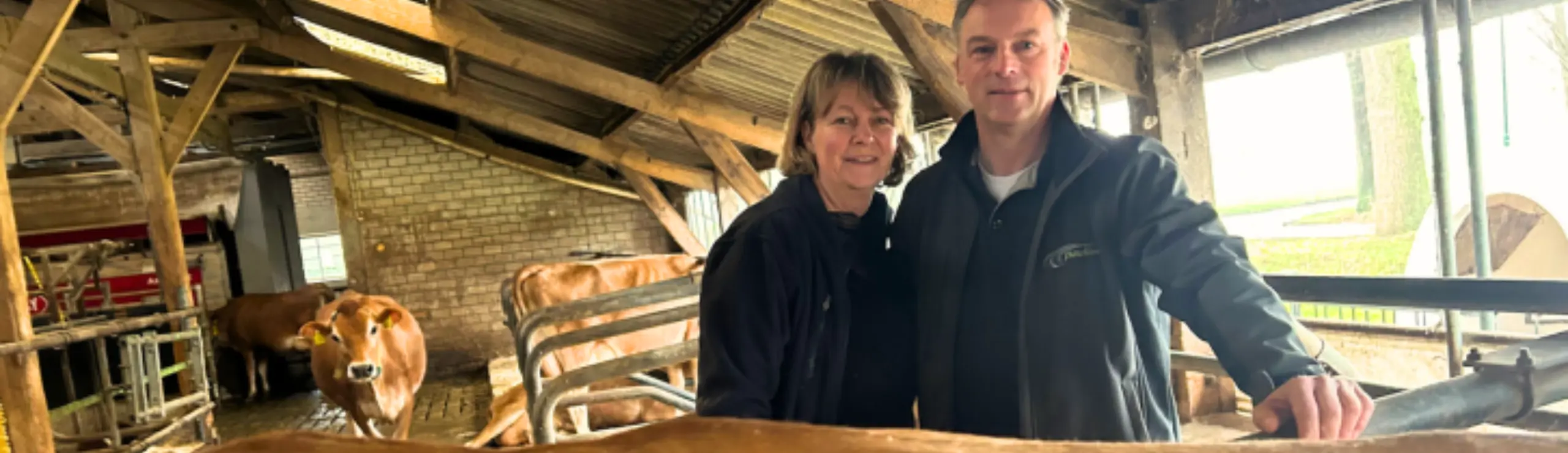
Jersey cows bring new life to an old barn in Haghorst (North Brabant)
In Haghorst, North Brabant, near Tilburg, lies the farm of Sander and Resita Paulissen. Since August 2025, they have been milking 40 Jersey cows in a barn from 1968 that had stood empty for many years. With the installation of a new Lely milking robot, the goal is to expand to 60 dairy cows. For Sander and Resita, the dairy farm is a side project: both also have jobs outside the farm. Nevertheless, they approach it professionally, with a clear vision regarding barn utilization, regulations, and genetics.
17.03.2026
Why Jersey?
The choice for Jersey cows was carefully considered. “It fits perfectly within the phosphate regulations in the Netherlands,” explains Sander. “You can keep about 30% more Jersey cows than Holstein cows within the same phosphate quota.”
In addition, the breed fits better with the existing barn. “When this barn was built, Holsteins were much smaller than they are today. The modern Holstein is simply too large for a barn from that time.”
A Jersey cow, on the other hand, measures around 130 cm at the withers and fits perfectly within the existing dimensions. The cubicles are 105–108 cm wide and suit the size of Jersey cows very well. In this way, an older barn gets a second life without major renovations.
Selection in Denmark
For the start-up, Sander and Resita traveled together with Harm Jan Brouwer, Sales Manager of VikingLivestock Netherlands, to Denmark to select the first animals.
There, 22 Jersey cows and 10 heavily pregnant Jersey heifers were selected. All animals were tested for paratuberculosis, Salmonella, and leptospirosis to ensure the highest possible health status.
In January 2026, additional heavily pregnant Jersey heifers were delivered, this time selected by Harm Jan himself. “After the first selection that we attended ourselves, we fully trust that Harm Jan knows exactly what we are looking for,” says Sander. “He had gained a good understanding of our wishes.”
The expectation is that the capacity of the milking robot will be fully utilized by the spring of 2026.
“He had gained a good understanding of our wishes.”
First results are promising
Sander and Resita are satisfied with the first results. The average age in the herd is low: about 80% are first-lactation heifers. Nevertheless, the production results are encouraging.
They expect an average annual production of around 6,500 kg of milk per cow, with 6.50% fat and 4.50% protein. Sander expects the average to increase as more older cows enter the herd. “Older cows simply produce more milk, which raises the average.”
The curious nature of the Jersey breed proved to be an advantage in combination with the milking robot. “In the beginning, it was almost too good,” Sander laughs. “There were many refusals. It seemed like they kept coming to check if there was some extra concentrate available.”
Breeding and genetics
The exact breeding strategy has not yet been finalized. However, it is clear that they want to retain the best genetics within the herd by using Jersey semen on the best animals.
Sander emphasizes the importance of genetic progress without inbreeding. “We want to work with bulls that have strong genetic values, but we must also keep a close eye on inbreeding coefficients.”